Showing posts with label Gardening. Show all posts

Wednesday, August 9, 2017

Brewster Historical Society's Captain Elijah Cobb House Museum


When showing historical homes to clients, occasionally one will make such an impression on me, that it will be stuck in my head long after the showing.  The Elijah Cobb house in Brewster was just such a property.  I showed it to a lovely couple in 2013 when it was on the market.  The client, a professional preservationist, and I could not believe how pristine and in tact the house was.  It is unusual for a home to be so remarkably preserved, especially considering its 1799 date.

At the time, we were told that the Brewster Historical Society was interested in the property and we couldn't imagine a more fitting steward of this important georgian property, built by Captain Elijah Cobb.  Sometime later, I was delighted to hear that the Brewster Historical Society had indeed purchased the property and promptly got to work with the restoration.  I saw that Bob Hoxie of Great Hill Horticultural Services was designing and installing the gardens and I knew that I had to make a trip to see the finished results.

The house is a classic example of georgian architecture with its handsome symmetrical facade, hip roof, quoins on the corner boards, double interior chimneys and pedimented door surround with fanlight, framed by fluted pilasters.  By today's standards, the home is reserved, but in the day it was built, there could be no doubt that this was the home of a person of wealth and distinction.

Reeded hand carving on the mantel
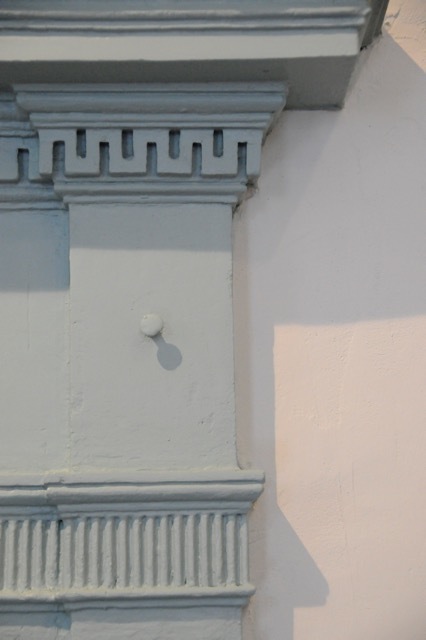
The interior of the home is equally preserved and impressive with its original floor boards, dentil and reeded moldings, elegant front stairs, and doors with early faux wood graining and stenciling.  Visitors enter from the ample back porch (a more recent addition), into what would have been the kitchen with its fireplace and beehive oven.  Along the east wall is a door which leads to the back stairs once used by servants to access their north facing bedroom.  This allowed the servants to slip down the back steps and start the fires and morning breakfast with minimum disturbance to the family.
Original kitchen
back servants stairs


In the front of the house are double parlors, one on each side of the graceful stairway.  The colors used in these rooms and elsewhere in the house are the result of careful research.  During the restoration, some paint chips were analyzed and the final colors selected by the curator, Leslie Aberle and the President of the Brewster Historical Society, and noted author, Sally Gunning.  The floor boards are painted with California Paints, Wooden Nutmeg.  The west parlor is painted Benjamin Moore's Homestead Green, the east parlor in California Paints Woodstock Rose and the trim throughout is in California Paints Phelps Putty.  The historical society consulted with Historic New England as well as a private historic preservationist during the restoration.
Dentil molding

Interior Shutters restored and operable


West parlor

East Parlor fireplace
East Parlor Victorian era photo courtesy of
Brewster Historical Society

Faux wood grain on upstairs bedroom door


Detail of stairway in front entry
Front door has both faux wood grain and stencil


Front door - the progression of locks through the years
Captain Elijah Cobb was born in 1768 and lead an exciting life as a ship's captain, taking him to far away places.  His exploits included rum running off the coast of Ireland and being taken prisoner during the War of 1812.  He ultimately returned to his farm overlooking Cape Cod Bay in 1820 and was very active, serving as town clerk, treasurer, inspector general, senator, and justice of the peace.

Captain Cobb's granddaughter, Caroline Dugan, features prominently at the Cobb house through the Brewster historical society's collections, including her photographs capturing Brewster in the late 19th century.  Caroline was born in the home and, in her early 20's, kept a diary detailing day to day life.  A favorite topic in her writings is her charming garden and the abundant nature surrounding her in what was decidedly, the country.  Her diary, embellished with her own photography, was published by The Brewster Ladies Library and can be purchased in the gift store.   For more on the garden, see my separate post here.

Exterior gardens inspired by Caroline Dugan's diary

Guest house late 19th century repurposing of an older carriage shed

The property had originally encompassed 92 acres and went right down to Cape Cod Bay.  In 1892, it had 12 acres left.  Below is an old photo that shows the guest house (above) and highlights the views that the house once had.

The carriage shed
Note that the property had views down to Cape Cod Bay


Great Hill Horticultural Services designed period inspired gardens

For more info, visit the Brewster Historical Society's website for directions and hours and to view a wonderful video tour:  http://www.brewsterhistoricalsociety.org/cobb-house/

The 2017 hours are 1 to 4 PM Wednesday through Saturday, June 28th - September 2nd.  
and 1 to 4 PM Saturdays from Labor Day - Columbus Day
The Elijah Cobb House is located at 739 Lower Rd., Brewster, MA

Caroline Dugan's beloved gardens at the Cobb House

Birdbath nestled in the sunflowers
When Bob Hoxie, owner of Great Hill Horticultural Services, was tasked with designing the gardens for the Brewster Historic Society's Cobb house, he got a little help from a very unlikely source, a previous owner who died in 1941.  Caroline Dugan, the great granddaughter of the shipmaster Elijah Cobb, was born in 1853 in the house now bearing his name and kept a lively diary from 1873 to 1878.

Circular garden with sun dial
Generous donations made the garden possible
In her diary, Caroline celebrates her fondness for nature and for her garden with her many detailed and poetic entries.

Excerpts taken from "From Painting a Time in text and photographs, The Diary of Caroline Atherton Dugan", Published by the Brewster Ladies Library, c. 2014

The smoke tree in the back framing the nasturtiums 
July 26.  Sunday.
p.32

Addie Nickerson called at sunset time.  She is most attractive & lovable.  - Our smoke tree is in full glory, a soft mist through which the sun shines.


As in Caroline's garden, the flowers display a
lighthearted mix of red, yellow pink and purple.

July 31, Monday.
p.79

"In gardens also, bloom coreopsis red & yellow, great sunflowers, nasturtiums, moneywort, balsams, white & red, smoke, mignonette, and sweet peas in every shade of white, pink and purple"


View towards the welcoming porch in the back

Bob, a historic landscape designer and curator, took inspiration from the descriptions of her beloved garden and incorporated the flora mentioned in her diary.  Many of the varieties of plants available to Caroline are not readily available today.  Fortunately, Bob starts heirloom seeds in cold frames in the spring to supply the historical gardens that he curates.  He explains that the inspiration for this garden came from Caroline's writings, photographs, and a sense that this is a Cape Cod country garden of a young lady in the late 19th century.  He wanted to avoid the look of a professionally designed and overly groomed and impersonal landscape.


Sweet pea scramble up the bamboo frame
One look at the charming nasturtiums meandering behind sweet pea, under the smoke tree, and spilling over the alyssum and you can see that Bob has hit the mark.  Some of the other plants include old fashioned roses, daisies, phlox, marigold, tiger lilies and dusty miller.

There is a second area that invites visitors to sit and relax on a stone bench while admiring the flowers surrounding a sun dial, also mentioned in Caroline's diary.

A place to sit and enjoy the garden
Bob is a master at bringing a historical landscape to life, allowing visitors to get a taste of the exuberance and curiosity of young Caroline as expressed in her garden.  Great Hills Horticultural Services works with historical museums but also with private homeowners of historic as well as newer homes.  Some of his works include gardens at the Plymouth Antiquarian Society, Plimoth Plantation, the Oyster Harbors estate of Rachel "Bunny" Mellon, and private residences across Cape Cod and the South Shore.  Check out his website, facebook page, and blog for more photos and info.


To purchase a copy of Caroline Dugan's diary, you may visit the beautifully restored Cobb House or contact the Brewster Ladies Library, 508-896-3913, www.brewsterladieslibrary.org.

The front facade of the handsome Cobb House Museum
To visit the Cobb House in person, check their website for seasonal hours (2017 hours: 1-4 PM Wed - Sat, June 28 - Sept 2, 1-4 PM Saturdays from Memorial Day through Columbus Day)


Thursday, March 28, 2013

Thoughtfully Landscaping your Historic Home

Plymouth Antiquarian Society's 1809 Hedge House Museum
Photo courtesy of Great Hill Horticultural Services

I had the privilege of sitting down with Bob Hoxie, owner of Great Hill Horticultural Services in Sandwich, MA to discuss landscaping historic properties and his recent work on the Plymouth Antiquarian Society's Hedge House garden restoration project.  Bob is a Massachusetts certified horticulturist with a wealth of knowledge and experience about historic landscapes.  In addition to serving for 17 years as the horticulturalist for a large estate, Bob was Associate Director of Historic Landscapes for Plimoth Plantation and former chairman of the Town of Sandwich's Conservation Commission.

Have you ever wished that you could just put on a pair of special glasses that would show you what your home and the surrounding landscape looked like in its hey day?  A historic home often bears traces of its history.  Sometimes the remnants are obvious, as is the case with a meandering stone wall.  But sometimes the historic landscape is hidden beneath layers of soil.  In the past two historic homes that I have had, we have discovered dry wells covered only by a few rotted boards and a thin layer of top soil.  Yikes!

Like interior restoration projects, bringing the exterior landscape back to life is best approached with careful planning.  Bob recommends assessing where you are in your life and what your goals are for the landscape.  Do you want a faithful period restoration or a period appropriate recreation that nods to the past?  How much time do you want to invest in the upkeep and maintenance of the garden?  Do you want to reflect the home's original construction date in the landscape or perhaps another significant time in the property's history?  Are there issues that you want to address, like highlighting a feature in the garden, or screening an undesirable view?  Once you begin to tackle these questions, you can formulate a plan and prioritize your goals.

Careful research and planning will result in a beautiful landscape that matches your lifestyle.
Photo courtesy of Great Hill Horticultural Services

Bob uses a variety of sources to research the home's historic role, including the county's registry of deeds, old newspaper articles and historic photos.  In addition, he explains that clues can be found by careful observation of the existing landscape.  A few stocks of a culinary herb may signal the historic presence of a kitchen garden.  Sometimes an archeologist will be brought in to do a test pit and provide additional information about the history of the site.

In tackling the landscape, Bob cautions owners to "do no harm" - a saying that is common in interior restoration as well.  Don't destroy original features that make the property unique and help to tell the story.  100 year old lilacs or remnants of a stone foundation can help root the landscape to the past.  There is a benefit in moving slowly.  He advises to think how you want the landscape to appear today as well as to plan for when the plants are mature.  Good planning and communication will lead to a successful design.

Work in progress at the Hedge House
Photo courtesy of Great Hill Horticultural Services

Another recommendation that Bob makes is to incorporate native plants into the design as part of the planting palette.  In this area, plants like mountain laurel or holly will require less maintenance.  However, these native species should be used in context.  We've all seen native shrubs used as foundation plants and sheared like giant meatballs!  When incorporating heirloom plants, don't forget to consider their historic purpose, whether that be aesthetic, culinary or medicinal.

One last suggestion - Bob advises to install plants that have room to grow.  If plants are too large, they give an "instant look", that will look crowded in a few short years.  And likewise, don't overpower a landscape with too many plantings.  Sometimes one or two feature plants are just what is needed.


Tuesday, June 5, 2012

Gardening with Native Plants to Enhance your Historic Cape Cod Home

This charming cottage garden complements the simple lines of a traditional Cape
Designed by Chris Kolb, Ark Gardens, photo courtesy of Ark Gardens
Historic homes are inherently "green", preserving the embodied energy of the building materials used to construct them, while keeping those materials out of the landfill.  What better way to complement your historic home than with an equally environmentally sensitive garden?  On the Cape, while we are blessed with an abundance of natural beauty, we are also mindful of how fragile our environment is.  With a shallow aquifer, it just makes sense to incorporate native species that are drought as well as disease tolerant.


The cottage garden above is planted in what Chris Kolb, of Ark Gardens, refers to as a patchwork garden.  Like a patchwork quilt, it incorporates contrasting colors and textures in rectangular blocks of plantings.  The result is a charming cottage style garden which beautifully complements the simple cape style home.


Cape Cod Rambling Rose roof trellis
Photo courtesy of Ark Gardens

Close up of Cape Cod Rambling Rose Covered Roof Trellis
Photo courtesy of Ark Gardens

Inkberry, Photo courtesy of Ark Gardens
Ark Gardens in Sandwich specializes in creating gardens that respect the earth with a playful mix of traditional plants and native species.  Some plants arrived here with the colonists and have proven their suitability to Cape Cod's sandy soils and sea breezes.  Plants like lilac and Virginia roses are happy companions to native plants like Inkberry, Golden Aster and Lupine.   The Cape Cod Commission posts a wonderful list of native species suitable for the cultivated cape cod landscape.

Even the ubiquitous hydrangea has a native variety, Hydrangea arborescens,  that is better suited to the local growing conditions.


Healthy Hydrangea arborescens next to a struggling non-native Hydrangea macrocarpa under dry oak shade
Photo courtesy of Ark Gardens

Hydrangea arborescens 'Annabelle'.
Pink variety called 'Bella Anna'
Photo courtesy of Ark Gardens


Virginia Rose is native, pretty and low maintenance
Photo courtesy of Ark Gardens
Chris explains that part of a garden's success stems from the attention that he gives to establishing site lines that complement the existing architecture.  Ark Gardens philosophy is to approach an existing garden with a conservative eye, retaining, pruning or replanting established plantings when possible.

Plants can also serve multiple purposes.  Oregano, quince, savory and blueberries, while being attractive have the added benefit of adding edible leaves, bulbs or fruits to the garden.  Visit Ark Gardens website for more information and for a coupon good for a free design sketch and consultation.