Tuesday, February 26, 2013

Tips for Staging your Historic Home


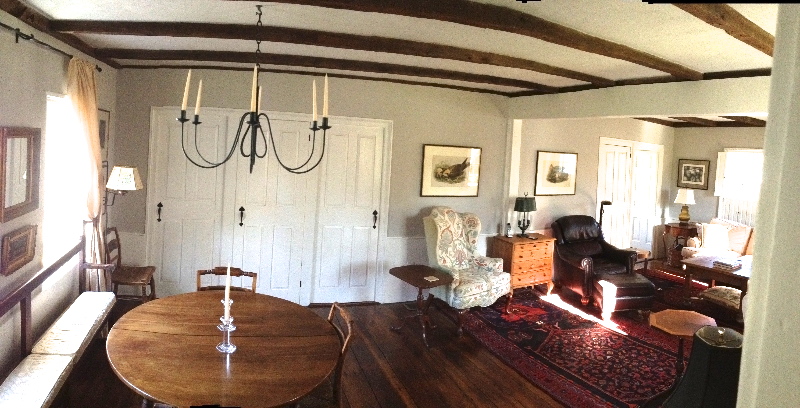
Historic Homes have a lot going for them.  They have interesting architectural features like beehive ovens, window seats, plaster medallions, gunstock corners and hand carved mantels.  But sometimes these features are buried under the homeowners other passions, whether they be a collection of baskets, or a flock of decoys.... you get my drift.  Historic homes rarely suffer from not having enough personality.    To make your historic home more appealing to a broader range of buyers, I've gathered some of my favorite tips.

1.  Remove heavy window treatments.  

I know, I know, you had them custom made, with fabric that was woven on a 19th century loom, to match the period of the house. I do appreciate that.  But not all buyers will.  Festoons and jabots can make a space seem dated - not in a good way. Simple linen panels or roman shades will update your look.  If you have a nice view, you can remove the treatments altogether and let the wood trim be the star.

Benjamin Moore - Wedgewood Gray
HC- 146
2.  Paint color.  Nothing says 1980's in an 1880's house like mauve and powder blue.  Paint color is easy to fix and nothing gives a bigger bang for the buck.  For a safe and sophisticated pallette, choose colors from the Historic Color charts, like Benjamin Moore or California Paints.  Historic colors are usually low in saturation - they are greyed down to a sublte hint. Choosing a soft, neutral and modern color will go a long way towards making the house feel fresh.  For rooms that adjoin each other, consider painting them the same color to visually expand the space.  Not sure what color to choose?  Open a Pottery Barn or Ballard Design catalog and there will be many nice colors to chose from, complete with the manufacturers name and code.

3.  Lighting.  

Ceiling light - Pottery Barn
I'm not suggesting that you remove your original Tiffany chandelier from your Edwardian house.  But, let's face it, in most houses the original chandelier (if there ever was one) is long gone with the wind. And many "reproduction" lighting options are just plain bad.  This is another area where a few simple, inexpensive changes can make a huge difference.  Consider the effect of replacing your brass "colonial" chandelier with a linen drum shade hanging over a scrubbed pine dining table with black birdcage windsor chairs. Updated lighting can make the antiques feel more approachable and less like a museum.  This goes for table lamps as well.

4.  Simplify.  

This is a standard tip for all staging, but it is especially important in an older home that may be the repository of many years of family heirlooms and carefully amassed collections.  Find that balance between a stripped bare, cold, sterile environment and "where the heck is the sofa hiding".  I usually like to aim for a second home look.  You know, where there are some decorative accesories that help provide a sense of place and charm - a slipcovered sofa, a beautiful throw, candles, local artwork.  
Stitch and Sew slipcovers on Cape Cod

But the "stuff" that inhabits the homes of mere mortals is packed in a storage locker 20 minutes away.  Small pieces of furniture and accesories can look busy, especially in photos.  80% of buyers are looking online first - so it is important that your spaces look good in photos.  To help declutter - take some quick photos and look at them on your computer.  Where is your eye drawn to?  Is it focussed on that beautiful mantle, or the jumble of cords stuffed under the side table? 

Simplify... maybe the bed doesn't need an army of decorative pillows.  Perhaps a simple quilt with crisp white sheets and pillowcases and a vase of flowers on the bedside table would be more inviting.
The Paper Mulberry


5.  Furniture arrangement.  This can be very tricky in an older home where our forefathers seemed to think that every wall must be punctuated with as many windows, radiators and doors as possible.  Where's the TV to go?  Think - what is the most winning architectural feature in this room?  If it's the windows - don't block them, if it's the fireplace, don't put a bookshelf in front of it (don't laught - I've seen that).  If navigating through the room requires a light house at the far side to keep you from running aground, remove some furniture pieces.  

6.  Kitchens and baths.  
athomearkansas.com
Perhaps this one should have been first.  Updated kitchens and baths sell homes.  However, these can also be big budget areas.  To make a big impact but keep costs down, focus on the flooring and the vanity in the bathroom.  If your bathroom is sporting gold floor tiles with peach roses, you can easily get a whole new look with simple gray peel and stick tiles from the home store.  A neatly folded stack of fresh white towels on the open shelf of a simple painted vanity and your are in business.  

If your kitchen is dated, don't be afraid to paint the cabinets.  The wood tone of kitchen cabinets is a dead giveaway to the year it was installed.  Paint them white, replace the hardware and clear off the countertops.  Make sure the appliances are up to the white glove test.  If you are lucky enough to have a pantry, make sure it is not jam packed.  Use baskets to help corral like items and make the space more visually cohesive.

7.  Take great photos.  
http://www.arkgardenslandscaping.com


My parting advise is true for any home staging.  It is important, vitally important, that your photos look good.  You will probably need extra light sources when taking the photos.  Have fresh fruit in the kitchen and flowers on the wicker porch table.  It also helps to give a hint in the photo as to what room connects to the one you are in.  You may even want to light the adjoining room to help give a feeling of how the house flows.

After staging your historic home to appeal to buyers, don't be surprised if you remember why you fell in love with it in the first place and decide to stay put. 

Wednesday, February 13, 2013

Happy Valentines Day!

For the preservationist with a romantic (and humorous) heart, check out this blog "Preservationist Ryan Gosling"

Preservation minded folks apply captions to photos of the actor, Ryan Gosling - a preservationists dream.


Tuesday, January 29, 2013

Using the Bee Hive Oven in your Historic Home

I admit it, I'm cold.  With temperatures below freezing day after day, I'm dreaming of lighting a fire in our cozy early 19th c. cape.  Oh wait, I can't. Because a previous owner took the chimney down below the roof line on one chimney and the furnace is vented through the other.  Sound familiar?  Opening and using our chimneys is on my "to do" list.  Until then, I have to live vicariously through those of you who actually have working fireplaces.

There is one feature in the kitchen fireplace that I particularly would like to see working.... the bee hive oven.  I have visited Old Sturbridge Village and the Nye Family Homestead on days when they are demonstrating hearth cooking.

Nye Family Homestead, E. Sandwich, MA
Autumn Gathering
I learned that everyday baking, say some rolls for dinner, could be cooked on the hearth using a tin kitchen.  You've probably seen "tin kitchens" used to roast meat in the open hearth.  Some were fitted with a rack to allow a pie, rolls or cookies to be baked at the hearth.  However, one day a week, the bake oven would be fired up to do the major baking for the week.

Illustration of a tin kitchen - this one fitted with a rotisserie 

The process involved building a fire in the oven (the upper chamber) which was vented by a flue to the chimney.    The fire would be fed until about an armload of seasoned wood was burned.  At the beginning, the metal oven door would be propped against the opening, allowing some air in.  When the wood burned to coals, the door would be closed to conserve the heat.  The process would take approximately 1 1/2 hours.  To test whether the oven was hot enough, a cook would put her hand in the oven and count.  If she could count to 20 without having to withdraw her hand, the oven was cool enough.  But if she could count to 30, it was not hot enough for bread.

Under the bake oven opening, there is another square opening.  This is the ash pit.  It is not vented with a flue and sometimes has a wood ceiling.  It is not meant to have a fire, or hot ash in it.   Once the oven is hot enough, the coals and ash are removed with a metal peel and put in a corner of the fireplace.
The oven floor is cleaned with a water soaked broom.

When the oven is at the proper temperature, the items that need to be cooked at a higher temperature, like breads and rolls are put in first.  They are followed by pies and cookies and finally baked beans.

Have you used your bake oven?  Please share your triumphs (and defeats!)

I've always wanted to take classes in hearth cooking.

There are some upcoming classes offered at Old Sturbridge Village:

Families Cook, $85 - school vacation week, Feb 20, 2013
Dinner in a Country Village, $85 Booking for 2014

and at the Caleb Nickerson House in Chatham, MA
Hands on Beehive Oven Baking, Feb 3rd, 2013 Noon to 3PM
Open Hearth Cooking Class, March 10th, 9 AM to 4 PM

For more info on hearth cooking and baking:

"The Forgotton Art of Building and Using a Brick Bake Oven, How to date, renovate or use an existing brick oven, or to construct a new one".  Richard M. Bacon, Alan C. Hood & Company, Inc. Chambersburg, PA Copyright 1977

"The Open-Hearth Cookbook, Recapturing the Flavor of Early America", Suzanne Goldenson with Doris Simpson, Alan C. Hood & Company, Inc. Chambersburg, PA Copyright 2006

"Old Sturbridge Village Cookbook, Authentic Early American Recipes for the Modern Kitchen", Edited by Debra Friedman and Jack Larkin, Three Forks, Guilford, Connecticut, Helena, Montana, Copyright 2009

"Our Own Snug Fireside, Images of the New England Home 1760-1860", Jane C. Nylander, Yale University Press, New Haven and London, Copyright 1994


Wednesday, November 28, 2012

18th Century Half Cape for sale in S. Yarmouth, offered at $479,000


Historic Half Cape near Bass River in South Yarmouth for sale
It was a treat to preview this gorgeous, 18th century, half cape home which sits on a lovely half acre, walking distance to Bass River and Nantucket Sound beaches.  Amazingly, the home began its life on the island of Nantucket and was later floated over to Cape Cod.  For historic home enthusiasts, this house is the holy grail.  The owners, Nancy and Garry, who are experienced in restoring antique homes, have a keen eye for detail.  Each and every 9 over 6 window was removed, stripped back to bare wood, and reglazed and painted, preserving the charming wavy glass.  Wide pine floors anchor the rooms in a deep warm finish.

Large open dining area and living room


And the kitchen, Oh, the enchanting kitchen!  Nancy lovingly scraped years of paint off a corner cupboard, exposing the charming original blue finish.  It sits proudly on the new marble counter where it provides stylish, ample storage.

Original corner cupboard in kitchen

Proof that a small kitchen can prompt drooling...

modern conveniences meet historic charm in the kitchen

This cozy home includes 4 bedrooms, and 2 1/2 baths.  The master suite is a private oasis on the second floor.

light streaming into the window at the bottom of the stairs

spacious master bedroom suite under the eaves
Each of the bathrooms include special touches like this brown transferware bowl and oil rubbed bronze faucet.

horizontal boards add charm to the bathroom

Another original find, the antique scrubbed pine
bureau has been repurposed in the master bath
For more details, or to schedule a showing, please contact:  Lisa Hassler, Decoy Realty, lisa@HistoricHomesCapeCod.com, 774-994-1337.

Tuesday, October 16, 2012

Houses that go bump in the night


You've taken a listing on an old house that looks like the Adams Family just moved out and is rumored to have more ghosts than fleas on a dog.  You're showing the house to a prospective buyer who asks if the house is haunted....  Well, what's a real estate agent to do?

In real estate parlance, this property would be called "Psychologically impacted", which under Massachusetts law, an agent is not required to disclose.  The term includes properties that are impacted due to the previous owner having certain illnesses, if the property was the scene of a murder or suicide, or if the property is said to have had "parapsychological or supernatural activity".  Seriously.   I'm not kidding. Ghosts.

However, a real estate agent must answer questions about a property honestly to the best of his/her knowledge.  So if you want to know if Lizzie Borden took an ax..., you need to ask.

At least in Massachusetts.  Other states may have other rules.

And you may want to ask.  Maybe you don't believe in ghosts, and it really doesn't matter to you whether the previous owner claimed to have seen dear deceased Uncle Henry periodically climb the stairs at 2 AM.  However...... it might matter to others who know the house's story.  It might matter enough to negatively effect the value of the home.  According to a study done by Wright State University's James Larsen and Joseph Coleman, a psychologically impacted property will take 50 percent longer to sell and will sell for an average of 2.4 percent less than comparable homes.

Not to mention the lack of privacy from gawkers.  The Lutz family claimed that they had experiences paranormal activity in their home which inspired the Amityville Horror book and movie.  When they sold the house, the new owners won a lawsuit against the Lutz', claiming that the book and movie instigated a parade of sightseers, invading their privacy.

But maybe tourism is what you are after.  The Lizzie Borden house in Fall River, MA is an operating Bed and Breakfast and conducts tours of the home to eager ghost hunters.

Here are some local B&B's that are said to have strange happenings:

The Orleans Inn:  Is it the ghost of Hannah from the days when the Inn was a brothel that lingers on?  The Inn was the subject of a paranormal investigation by TAPS, The Atlantic Paranormal Society.  See the article in the Cape Cod Times, 4/20/10.

The Penny House Inn (Eastham):  Included in the book Haunted Houses of Cape Cod, this Inn has a Halloween special package.

The Dillingham House, Sandwich:  This Inn has long been thought of as being haunted.  Perhaps it is Branch Dillingham who committed suicide there in 1813 or one of his children.

The Beechwood Inn, Barnstable:  Read about the Mischievous Lady who haunts this Inn in an article, The Lady Vanishes, published by the Boston Globe, October 31, 2007.

While you are staying at a haunted Inn, you can join the popular haunted walking tour with the Cape and Islands Paranormal Society in Barnstable.

Happy Halloween!


Friday, September 14, 2012

Save this (small) Historic House!

1 Harbor Street, Sandwich, MA on beautiful Cape Cod is listed by David Holt at Today Real Estate and is on the market for $130,000.  At just 948 square feet, it can certainly qualify as "small". Unfortunately,  too often, in historic real estate, size matters.  When a large saltbox home that graces the village green falls into disrepair and is threatened with demolition there are cries from preservation groups to save it.  But what happens to the humble cottage - the dwelling house of the fisherman or the factory worker?  The land is often deemed of greater value than the home itself.

When Old Sturbridge Village was seeking a small house to add to its collection - they had such a hard time finding one that they ended up building one.  This, despite that fact that houses under 800 square feet once made up a quarter of our housing stock in the early 19th century.

Small House at Old Sturbridge Village, MA
Small houses are an important part of the fabric of our history.  Some communities have recognized their value and have protected them with charming results.  A visit to 'Sconset on Nantucket greets you with a collection of small fisherman cottages dripping with roses.

Rose covered Sconset cottage

This home on Harbor Street in Sandwich has a long history and was once used as a dwelling house for workers in the Boston and Sandwich glass factory.  Neighborhood folklore hints at an even longer history for this house - it is rumored to have been moved here in the early 18th century.  The exposed beams with bark on them in the kitchen suggests an early date for this home.  It has much to offer in a great neighborhood, walking distance to ice cream, restaurants, shops and the beach.  No doubt - it needs work, but it CAN be saved.  And at $130,000, there is room for restoration costs.

1 Harbor Street, Sandwich MA


Wednesday, August 29, 2012

Evening Gala "Hats off to Historic Preservation" 9/29/12 5:30 to 7:30 PM


Briggs-McDermott House
From website of Bourne Historical Society
Join preservation minded folks at an evening gala to be held on Saturday, September 29th from 5:30 to 7:30 PM at the Briggs-McDermott House, 22 Sandwich Road, Bourne Village.

The Briggs-McDermott House is on the National Register of Historic Places.  This Greek Revival-style house has been restored and furnished to reflect the period from 1840 to 1910.  The ceiling of the music room was painted in 1890 by famed marine artist and Bourne resident Charles Raleigh.

Eighteen models mingling with guests will be wearing vintage hats from the collection of the late Letitia Coppi of Sagamore.

Fine wines, craft beers and hors d'oeuvres included.  Music will be provided by the members of the Cape Cod Conservatory.

Tickets, $25 each, are limited and must be reserved in advance.

Early reservations are recommended:  508-563-6245 or 508-274-3440.

Sponsors of this event include Cisco Brewers of Nantucket, Portside Liquors of Pocasset and Cape Cod Five Bank Charitable Foundation Trust.